Showing posts with label policymaking. Show all posts

07 October 2017

Short termism: taking advantage of complexity

There's much of interest in John Kay's presentation at the Public Hearing on Sustainable Finance at the European Commission. The key point is this:
Short termism is the product of the intervention of intermediaries. Evolution of the financial system over the last 40 years has been characterised by the steady growth of the process of intermediation, a process which has taken finance further and further away from meeting the real needs of the underlying users and suppliers of finance. Market-based capital allocation and long-term decision-making do not fit easily together. John Kay, 18 July
There's a mismatch between people's long term goals, and the short-term focus of the people who are supposed to help us achieve those goals. The same sort of mismatch occurs not only in finance but also, though perhaps less pervasively, in healthcare and education. Reasons vary, and are not easy to pin down. Information asymmetry may play a big role: in finance, as in healthcare, providers know a lot more than customers. Society is complex and large institutions are adept at misusing that complexity to take advantage of our relative ignorance. In fact, they are not above manipulating the regulatory environment to add to our confusion.

The more important question, though, is how to close the gap between what we want to see, and what our public- and private-sector institutions deliver. My suggestion is that we articulate long-term social and environmental goals, and reward people for achieving them. We don't need to prejudge intermediate steps, nor specify who shall achieve our goals. If we issue Social Policy Bonds with the aim of improving our citizens' health, say, or achieving universal literacy, then intermediaries will proliferate only if bondholders think them necessary to reach our targets with maximum efficiency. Information asymmetry means that intermediaries can take advantage of our relative ignorance about how best to achieve our personal long-term goals and substitute their own, usually much shorter-term objectives, which rarely coincide with our goals and often, indeed, conflict with them. But whereas we might not know how best to achieve our personal goals, nor society's goals, we are not at all ignorant about what those goals actually are. Social Policy Bonds would recast the way we, as a society, do things. They would put our broad, long-term, goals back where they belong: as top priorities, to which our institutions and all their activities are entirely subordinate.

06 June 2017

Self-entrenching atomisation

In a discussion about air travel, Steve Randy Waldman makes an interesting point:
Aggregate outcomes are not in general or even usually interpretable as an aggregation of individual preferences. When we learn about the Prisoners’ Dilemma, we don’t interpret the fact that both players rat as evidence that, really, they both just wanted to go to jail for a long time. After all, that is their revealed preference, right? No. We understand that the arrangement that would obtain if they could cooperatively regulate one another’s behavior is in fact the outcome that they would prefer. As isolated individuals, they simply have no capacity to express this preference. Source See also Prisoner's Dilemma
This explanation of the mismatch between the sum of individual preferences, and aggregate decisions makes a lot of sense, and we can see its implications beyond the air travel industry in the deficiencies of our policymaking system. (I'm not, incidentally, convinced by the rest of Mr Waldman's discussion of the air travel industry.) To my mind, it points to the need for more public engagement with policy; more discussion amongst ordinary people about the costs and benefits of policy alternatives. But policy itself is not really the issue: policy is a means to various ends, and those ends under our current system are rarely articulated, often  deliberately obscured, and often in conflict with each other and with the interests of anybody except those bodies wealthy enough to follow and influence them. We don't  "cooperatively regulate one another's behaviour" in the policymaking process, because that process is just too esoteric and time-consuming for ordinary people to follow.

The result is that our politics is ceded to powerful bodies, public- and private-sector, which benefit by ordinary people's unwillingness or inability to follow the policymaking process. A self-entrenching mechanism seems to be at work: certain policies weaken social and family bonds. I'd include amongst these policies that deal with welfare payments, subsidies to (for instance) road transport and capital-intensive agriculture, zoning laws, regulations that favour big business, and trade agreements. Importantly, the positive effects of these policies might well outweigh the negative, but the negative effects do tend to divide us. And, as atomised individuals or nuclear families, we exhibit exactly the behaviour that Mr Walden talks about: we cannot translate our wishes through a broken policymaking system, into 'an aggregation of individual preferences'. This cycle perpetuates itself.

Social Policy Bonds could help. They would refocus policy discussion onto outcomes that are meaningful to ordinary people. Goals, in short, that we could understand and debate. Under a bond regime anyone could engage with the policymaking process and, crucially, with each other, over policy goals and priorities. Even if our individual wishes were over-ruled, we'd have the satisfaction of knowing we'd been consulted. One result of this would be more buy-in: a crucial feature missing from politics these days. Another would be the solution to the problem to which Mr Waldman alludes: our individual preferences could be aggregated in a meaningful way. For example: few of us would want to see, say, a conflict anywhere in the world that led to the detonation of a nuclear device. Or, at the national level, most of us would like to see universal literacy and reductions in the level of violent crime. Currently, we have no way of articulating and debating these preferences in a systematic way: we can vote for political parties that may or may not offer different perspectives; we can join single-issue groups (which tend to deviate from their initial remit), and there are various other ad hoc activities we can undertake in support of some, but not all, of our individual goals. But they're unsystematic, often incoherent, and rarely exposed to moderating or contrary argument. And a large number of interest groups anyway replicates almost exactly the mismatch discussed above.

In contrast, a Social Policy Bond regime would enable us meaningfully to express goals that our current system finds difficult to target: goals like the avoidance of a nuclear conflict. The bonds could do this effectively because they would not presuppose how our goals shall be achieved, nor who shall achieve them. By focusing entirely on outcomes and costs, Social Policy Bonds would translate and modify our individual preferences into coherent, consensual policy goals. An invaluable by-product of a bond regime would be its reversal of the atomisation process afflicting western democracies.

30 May 2017

Focus on outcomes, not party

Matt Taibbi discusses the US Democratic Party's reaction to the Bernie Sanders campaign, in a piece originally penned on 9 June 2016:
Politicians are so used to viewing the electorate as a giant thing to be manipulated that no matter what happens at the ballot, they usually can only focus on the Washington-based characters they perceive to be pulling the strings. Through this lens, the uprising among Democratic voters this year wasn’t an organic expression of mass disgust, but wholly the fault of Bernie Sanders, who within the Beltway is viewed as an oddball amateur and radical who jumped the line. Nobody saw his campaign as an honest effort to restore power to voters, because nobody in the capital even knows what that is. In the rules of palace intrigue, Sanders only made sense as a kind of self-centered huckster who made a failed play for power. Matt Taibbi, Insane Clown President, January 2017
Exactly. We need to reconnect politicians and their parties with voters. Policymaking systems have been subject to two principles which I deem axiomatic:
  • Every organisation, be it a church, trade union, university, political party, large corporation or whatever, will always seek to overplay its hand. 
  • Every organisation will, sooner or later, forget its founding ideals and its stated objectives, and devote its energies to self-perpetuation.
So political parties are no better, and not much worse, than any other large organisation, except in their oligopolistic power over the rest of us. I think our policymaking models are outdated. In the western democracies we choose a person or a party who promises to do something to help achieve some vague, usually unverifiable outcome at some indefinite time in the future, usually long after they can be called to account. It's a very indirect form of influence, and one that, as we see, has been corrupted, so that the link between the voter and the politician is distorted and broken by wealthy interest groups, whether they be corporations or government agencies who don't want their boat to be rocked.

I propose that instead of choosing people or parties, we choose outcomes: explicit, verifiable outcomes that are meaningful to ordinary people. Which means outcomes that are not phrased in terms of expenditure, institutional size, structure or remit, or regulatory or legislative powers. Outcomes such as improved health, or world peace, that people can understand, and that we can help choose and prioritise. I am not necessarily advocating Social Policy Bonds here: a shift toward discussing outcomes and their costs would be an improvement over our current systems. But Social Policy Bonds could focus debate more, and have the crucial advantage that they inject the market's incentives and efficiencies into all processes necessary to achieve society's goals.

23 May 2017

Economics and politics: closing the gaps

Elisabeth Jacobs, in an essay, about Thomas Piketty's book Capital in the Twenty-First Century, says that politics is 'everywhere and nowhere' in his book. The reviewer points out that:
A focus on efficiency is unobjectionable in a world in which political and institutional stability can be taken for granted, much less so in a world in which it cannot. ... [E]conomists set themselves too easy, too useless a task if they can describe how capitalism works only when politics is unchanging. A new anthology of essays reconsiders Thomas Piketty’s “Capital”, the 'Economist', 20 May
Quite so. I've questioned the limited purview of the economics profession before. Economists find it safer to describe the world as it is, and to try (and usually fail) to predict what's going to happen to certain macro-economic variables. (There are exceptions of course.) The gap between economics and useful endeavours mirrors that between politicians and the concerns of the citizens they are supposed to represent.

In both cases, I think Social Policy Bonds could help close the gap. A bond regime would take as its starting point broad goals that are meaningful to a population: goals that are inextricably linked to our well-being and that we can understand. And because we can understand outcomes such as improved health, or nuclear peace, we can participate in assigning their priorities. (Economists could, perhaps, make a useful contribution here.) Such participation will give us more understanding of the trade-offs that inevitably need to be made. We might not see our own priorities replicated exactly in those  that society chooses to target, but we shall have been consulted, and so have far more buy-in, than under any of the current policymaking systems.

I think that lack of buy-in goes a long way in explaining why our political systems are failing, perhaps catastrophically. The gaps between policymakers and citizens; between the rich, the bureaucrats, media, academics, and ordinary people, are growing ever larger. Consultation about the outcomes we wish to see would start to close these gaps. Injecting the market's efficiencies and incentives to bring about those outcomes with optimal efficiency, would take that process a step further. The ultimate goal would be a politics that improves all our well-being, making for a more healthy, more prosperous and peaceful, more contented and cohesive society. A Social Policy Bond regime, I believe, could achieve all that.

22 April 2017

Reinforcement learning and the public sector

Will Knight writes about reinforcement learning:
Reinforcement learning is a way of making a computer learn through experience to make a series of decisions that yield positive outcomes—even without any prior knowledge of how its actions will affect its immediate environment. A software-based tutor, for example, would alter its activities in response to how students perform on tests after using it. Reinforcement Learning, Will Knight, 'MIT Technology Review', March/April
It's the same approach practised by the computer called DeepMind, which 'mastered the impossibly complex board game Go and beat one of the best human players in the world in a high-profile match last year.' It's also, at least in theory, the basis of our economic system: the learning process that is supposed to go on through the creative destruction of business enterprises that fail to adapt to changing circumstances. As applied to driverless cars, 'the software governing the cars’ behavior wasn’t programmed in the conventional sense at all.' The software learns through trial and error.

Large corporations and their friends in government have seen to it that competitive markets play a lesser role than they should in determining our economic prospects. Corporations succeed today not so much through competing in markets, but more by manipulating the legislative and regulatory environment, and participating in effective cartels with other powerful players, both private- and public-sector. But the principle - that of survival of the most adapted, and the most quick to adapt - has generated enormous material wealth, and continues to operate, though more to the benefit of the already-wealthy than to ordinary people.

With its record of success, why isn't reinforcement learning, or competition to find the best approaches, allowed to operate in the public sector. That is, why don't we allow competition to solve our social problems? It's partly for  historical reasons. When governments began to take an interest in the welfare of ordinary people, solutions to their basic problems were fairly easy to identify. Requirements for things like sanitation, elementary education, a police force, fire engines and hospitals were - and are - difficult to argue against. But as society has grown more complex so too have our social and environmental problems. How, for example, do we go about reducing crime, improving our (already relatively high) levels of physical health, improving our mental well-being, or ending war? No obvious solutions leap to mind.

Which is where Social Policy Bonds could enter the picture. Rather than let public-sector organisations have a monopoly on trying to deal with these problems, a bond regime would, in effect, contract out finding the best solutions to the private sector. A goal such as eliminating war is going to need the exploration, deployment and refinement of a multitude of potential approaches. More than that, though, it's going to need to reward the most effective of these approaches and to terminate the useless ones. There are well-meaning organisations working to end war, but the people working for them are not rewarded for their success. There are no built-in incentives for the organisations to find optimal solutions, nor for inefficient organisations to be dissolved if their efforts prove futile or counterproductive. The result is that the challenges humanity faces, including environmental calamities or nuclear proliferation, are nowhere near being effectively met. But, unlike computers learning how to drive cars, or businesses operating in competitive markets, our failed approaches and ineffectual organisations aren't terminated. Sometimes, in fact, our politicians pump even more money into them.

Social Policy Bonds would change that. They would channel the market's incentives and efficiencies into the discovery and implementation of diverse, adaptive and, above all, efficient approaches to our social and environmental problems, including those, like war, that many of us have concluded have no solution. Our current system places responsibility for the solution of our problems in the hands of large, usually monopolistic, organisations that face little competition and have no incentive to try diverse approaches. There's certainly no reinforcement learning. It is because of its ability to stimulate diverse, adaptive approaches that a Social Policy Bond regime could succeed where existing policies have failed.

15 April 2017

What are governments for?

George Monbiot quotes from Kate Raworth's Doughnut Economics, saying that:
[E]conomics in the 20th Century “lost the desire to articulate its goals.” It aspired to be a science of human behaviour: a science based on a deeply flawed portrait of humanity. The dominant model – “rational economic man”, self-interested, isolated, calculating – says more about the nature of economists than it does about other humans. The loss of an explicit objective allowed the discipline to be captured by a proxy goal: endless growth. Circle of life, George Monbiot, 13 April
I've inveighed for years against the de facto goal of governments everywhere which, in the absence of clear, explicit goals, has become economic growth, expressed as the rate of increase of Gross Domestic Product, or GDP per capita. The grievous effects of this mistargeting on income and wealth distribution, the environment, and much else, are now becoming apparent. More recently, I've asked What are economists for? Governments as well as economists have lost their way. As Raworth says, they do not think in terms of explicit goals that are meaningful to ordinary people. They are pre-occupied with process and complexity:
The Dodd-Frank bill, like Obamacare, is tyranny by complexity. Consider the Glass-Steagall Act, at 37 pages in length, and the 2,319-page monstrosity of the Dodd-Frank Wall Street Reform and Consumer Protection Act. Charles Hugh Smith, 6 April
The only people who follow and understand our policymaking system are those politicians, bureaucrats, academics, lawyers and lobbyists who receive monetary rewards, sometimes vast, for doing so. The 'rational economic man' just happens to be the person who, in our sad attempts to purchase things that used to be supplied by the commons, maximises economic activity: that is, GDP. I think most people now see the flaws in targeting GDP as if it were an end in itself, but we are less united over what to do about it. My suggestion is that we start to express our policy goals in terms of broad, verifiable, explicit outcomes that are meaningful to ordinary people. Social Policy Bonds could do this, and inject the market's incentives and efficiencies into the achievement of those outcomes.

Under a Social Policy Bond regime, governments could still do what they are good at: raising revenue to achieve our social and environmental goals. And, though it would be a departure for most of them, they could learn to articulate these goals, as expressed and debated by the people they are supposed to represent. They could even, through government-financed bodies, help achieve these goals, but only if, through the Social Policy Bond mechanism, bondholders have confidence in their ability to do so more efficiently than other investors in the bonds. The current model which as Raworth points out, is dominant - that of 'rational economic man' - assumes and entrenches a paradigm that undervalues and often conflicts with community, the environment, small enterprises, and ordinary people's mental well-being. The short-term interests, as measured by accountants, of large organisations, both public- and private-sector, are privileged at the expense of the the rest of us. Social Policy Bonds would change that, right from the start, by posing the question that we cannot continue to evade: what are governments for?

02 March 2017

How we decide

How we decide whom we shall vote for: Andrew Tyndall, a media analyst based in the US, monitors American broadcast news media at his website the Tyndall Report. He found that the overwhelming majority of the time spent by the US media in coverage of the run-up to last November's presidential election was spent on coverage of (1) the candidates and (2) polling.What about policy issues?
With just two weeks to go, issues coverage this year has been virtually non-existent. Of the 32 minutes total, terrorism (17 mins) and foreign policy (7 mins) towards the Middle East (Israel-ISIS-Syria-Iraq) have attracted some attention. Gay rights, immigration and policing have been mentioned in passing. No trade, no healthcare, no climate change, no drugs, no poverty, no guns, no infrastructure, no deficits. To the extent that these issues have been mentioned, it has been on the candidates' terms, not on the networks' initiative. Andrew Tyndall, 25 October 2016
From my viewpoint, it doesn't really matter whether we, the public, are more interested in personalities and opinion polls than issues, or whether the almost total absence of policy discussion reflects the preferences of the mainstream media. The important point is that we do not, as a society, debate the outcomes we want to see. Policymaking in all the democracies, not just the US, has become so obscurantist as to become inaccessible to all except those who are paid to follow it. All that's left for the rest of us is to discuss the personality flaws of the candidates, and how people react to them. It's not an edifying spectacle, nor is it one that makes for social cohesion. Powerful interests, with much at stake and resources to match, follow policymaking and influence it in their favour. We have, then, on the one hand government and big business (which these days includes much of academia) and on the other, ordinary people and small businesses. The gap between the two is already wide, and appears to be growing wider.

Social Policy Bonds could change that. They are focused entirely on the social and environmental outcomes we wish to see. 'We' meaning all society; not just policy wonks, ideologues and public- and private-sector interest groups. Social outcomes, under a bond regime, would be agreed and targeted for improvement. There's more consensus over such outcomes and the direction in which we want to move, than there is about the supposed ways of achieving them, or who we think will be better at achieving them - even when outcomes are actually under discussion which, as we see, is very seldom. And there's certainly more comprehension about what outcomes are than about the arcana that are such a feature of our current policymaking process. Of course, even under a bond regime, there would be disagreements about the priorities people would give to different goals but, importantly, even those whose strong opinions would be over-ridden, would have been consulted. More generally, with greater public participation in the policymaking process, there would be more buy-in - an essential feature that is largely absent from today's politics.

"How we decide" today is a risible process; one that is divisive and distracting. As a result "what we decide" is far removed from the concerns of ordinary people. Social Policy Bonds targeting broad, meaningful goals, would be a big improvement.

21 January 2017

What are economists for?

Markets are means, not ends

Though much of my working life was intended to promote free trade, I question most economists' adherence to it. On the grounds of freedom, I fully agree that governments have no business interfering with willing buyers' importing goods and services from willing sellers. With some caveats, concerning risks to plant, animal and human health, and labour and environmental standards, I do think people should be free to trade with one another. The other argument in favour of free trade is slightly more subtle, but no less persuasive: it's underpinned by the principle of comparative advantage. Essentially, it shows that international specialisation of labour can benefit all trading countries. There are, again, caveats, but generally the theory holds. My concerns are that, yes, a country, say, the US, will benefit from trade with China, but who within the US captures most of the benefits? Consumers, including many poorer consumers, do benefit from cheaper imported goods. But do those gains from cheaper goods outweigh the income lost from jobs now done overseas? Are most of the gains from free trade going to the owners of capital, rather than low-income labour? Comparative advantage says that even after compensating the losers countries benefit from free trade. The problem is that most of the losers are not being fully compensated.

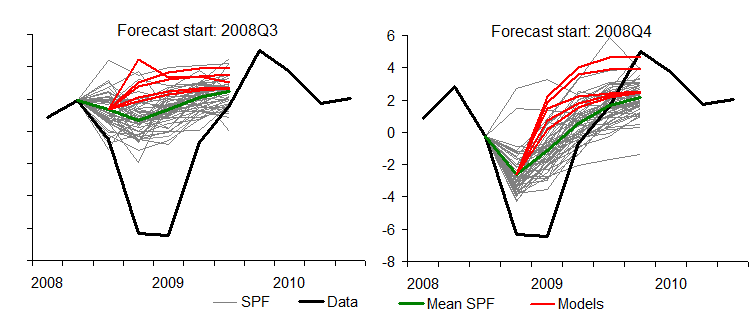
There's what appears to be a similarly misplaced ideological commitment to something called 'markets' in such policy areas as health and education where these are mostly run by government. Much intellectual effort has gone into trying to implant in the public sector those disciplines that characterise the creative destruction of the private sector. This is the sort of work in which my profession seems to revel. (Along, incidentally, with making false predictions: here's how successful they were in predicting the Great Recession:  "As you can see, even in the third quarter of 2008, the best models we have missed the big recession entirely.")
Source: Economists' biggest failure, Noah Smith, 'Bloomberg', 5 March 2015


I don't know whether such efforts have been successful; I'm not sure anybody does. They have certainly been divisive and morale sapping, and have expanded bureaucracy, and led to such wasteful distractions as Mickey Mouse micro-objectives and 'teaching to the test'.

This is where Social Policy Bonds could enter the picture. Instead of seeing 'free trade' and 'markets' as ends in themselves, why not see them as means to an end, and so why not target those ends directly? All the empirical evidence backs up economic theory that markets are the best means we have of allocating society's scarce resources. The definition of economics I was taught is the allocation of scarce resources in order to meet prescribed ends. Most countries don't bother with broad social or environmental goals. By default, therefore, the implicit goal becomes something like Gross Domestic Product per head, or its growth rate. Occasionally a social or environmental problem becomes so acute - and visual - that it becomes impossible to ignore, so resources are devoted to solving it. But we can do better than that. Instead of seeing free trade or markets as ends in themselves, we can yoke them to a higher purpose, as defined by society and its government. That would probably mean helping those severely disadvantaged, including those who suffer from the freeing up of international trade.

So I think society should define certain ends and use markets to achieve them. This has to be at a broad level, because resources can readily move between sectors. Under a Social Policy Bond regime, government would do what it is best at: articulating society's goals, whether they concern health, education, or extreme poverty; and raising the funds  necessary to achieve them. And markets would do what they are best at: allocating our scarce resources in order to achieve our social goals with optimum efficiency.


16 January 2017

Outcomes versus Justice

Sometimes we have to put aside notions of justice and fairness in order to achieve our goals:
Richmond to me is a story of pragmatism ... This idea that we’re going to step away from a purely ideological, moralistic approach to try new things and see what works. Barry Krisberg, criminologist at the University of California in Berkeley, quoted in A radical approach to gun crime: paying people not to kill each other, by Jason Motlagh, 'The Guardian', 9 June 2016

This (long) article discusses a programme in Richmond, California that entails paying people not to kill each other. Such payments amount to "a pittance compared with what Richmond police department must pay for overtime, or what the city pays for the cost of a criminal trial, or medevac helicopter rides to take shooting victims to hospitals." There are moral or ethical principles that might be being violated here, but that shouldn't be a bar to pragmatic solutions. It's not difficult to think of problems whose solution might mean that, for instance, killers aren't brought before a court of law, but instead are, essentially, bribed to give up (or decommission) their weapons. Real-world examples include the recent peace deal in Colombia, and deals made with men of violence in Northern Ireland and South Africa. In such cases, despite their crystallising injustice, the benefits to society as a whole far outweigh the costs.

They are not pure expressions of the Social Policy Bond ideal, but they do embody payment-for-outcomes, which is an essential element of that ideal. How would Social Policy Bonds differ? They would allow us to take a longer-term, broader, approach. A bond issue targeting gun deaths in Richmond, California, for instance, could target the reduction of gun deaths by 50 percent over a sustained period; say twenty years. Payments to potential killers might be one way of achieving that goal, but holders of those bonds would make such payments only when they are convinced that they are the most efficient way of achieving their goal - a goal which is exactly congruent with that of society. Still: it's a start.

30 December 2016

Working for a living

It doesn't matter whether the cat is black or white, as long as it catches mice. Deng Xioping
I'm not sure I fully understand the recent article entitled Shared stakes, distributed investment: Socially engaged art and the financialization of social impact by Emily Rosamund, but it did make me think about the apparent disdain that some have for worthwhile activities when they are undertaken mainly for financial gain. Social Policy Bonds have been in the public arena for something like 28 years now and their non-tradeable variant, Social Impact Bonds, are now being issued in about 15 countries. In my experience, it's been the ideologues on the left that are most opposed to the concept.

Often implicit, sometimes explicit, is their feeling, or argument, that Social Policy Bonds are a means by which investors make money out by doing what they should be doing anyway. It is true that some wealthy bondholders could become even more wealthy by first buying Social Policy Bonds, then doing something to achieve the outcome that they target, then selling their bonds for a higher price. This some call "profiting from others' misery" and it offends their sensibilities.

But it can also be called "working for a living while doing something socially useful". In the long run it's quite probably that only a few people or organizations will amass huge fortunes under a bond regime, even if they do successfully achieve society’s goals and profit from their bondholding. The way the market for Social Policy Bonds works would mean that excess profits could be bid away by competitive would-be investors. The market for the bonds would openly transmit a huge amount of information, that will indicate the constantly varying estimated costs of moving towards a targeted goal (see chapter 5 of my book for a full explanation). Barriers to entry into helping with target achievement could be low, especially if most bonds are held by investment companies who would contract out the many diverse approaches necessary to achieve most social and environmental goals.

The absolute sums of money at stake might be huge, particularly for Social Policy Bonds that target apparently remote, national or global goals, but there’s no particular reason to assume that, in the long run, it would be shared out any less equitably than, say, teachers’ salaries. Teachers? Yes, and nurses, doctors and social workers, all of whom perform socially valuable services for which nobody, even on the left, begrudges payment.

27 November 2016

Policy for the post-truth era

US President Barack Obama talks about the new media system which:
...means everything is true and nothing is true. ...An explanation of climate change from a Nobel Prize-winning physicist looks exactly the same on your Facebook page as the denial of climate change by somebody on the Koch brothers’ payroll. .... Ideally, in a democracy, everybody would agree that climate change is the consequence of man-made behavior, because that’s what 99 per cent of scientists tell us. And then we would have a debate about how to fix it. That’s how, in the seventies, eighties, and nineties, you had Republicans supporting the Clean Air Act and you had a market-based fix for acid rain rather than a command-and-control approach. So you’d argue about means, but there was a baseline of facts that we could all work off of. And now we just don’t have that. It happened here, David Remnick, 'New Yorker' dated 28 November
Science isn't a consensual process though, so even if the majority of scientists agree 
on one thing, whether it's anthropogenic climate change, or acid rain, or whatever, that should carry no more weight than the collective wisdom of experts in other fields, such as economists or opinion pollsters. There is a genuine problem here: how should we make policy when the relationship between cause and effect in our ever more complex societies is impossible to identify? It's not simply a question of following the opinions of existing bodies often backed by vested interests - nor of reflexively ignoring them: they might after all be right as well as self interested. Nor should we simply identify a problem then mindlessly dole out funds to the organizations whose stated objective is to solve it, but whose over-arching objective - in common, I think, with all organizations - is self-perpetuation.

We should instead recognize that resolving complex social and environmental problems, cannot wait for our receiving perfect information about causal relationships, and nor should we delay making decisions until such information becomes available - it might never happen. Take climate change: it's likely that, by the time we know the effects of man's greenhouse gas emissions on the climate, it will be too late to do anything to avoid or reverse their catastrophic effects on the environment. The current way of addressing the problem seems inadequate: extravagant gestures that might lead to some reductions in emissions that we think contribute to climate change, which might lead to some tiny, almost imperceptible (but unverifiable) effect on the climate some decades hence.

I think we can do better than this. We could use the Social Policy Bond idea, first to identify exactly what we want to achieve; and second to channel the market's incentives and efficiencies into achieving it. With climate change, we need to clarify whether we are more concerned about climate change, or about the impacts of climate change on human, animal and plant life. In other words, we define the outcome that we wish to achieve, then let the market decide how best to go about achieving it. Most social and environmental goals will embody an array of conditions that have to be satisfied for the goal to have been deemed met and the Social Policy Bonds redeemed. Our climate change goal should embody measures of physical, biological, social and financial variables that shall have to fall within a targeted range for a sustained period before the redemption of Climate Stability Bonds.

And as with climate change so with other major challenges.The important point is that the Social Policy Bond principle works even when the facts about what causes climate change, say, or crime, or war, are disputed. As such, Social Policy Bonds are the perfect policy instrument for today's post-truth politics.

Update 5 December: a version of this post for newcomers to the Social Policy Bond idea is available here

05 November 2016

Consensus and politics

Maria Bustillos introduces the concept of dismediation:
Dismediation is looking to make you never really trust or believe a news story, ever again. Not on Fox, and not on NPR. It’s not that we can’t agree on what the facts are. It’s that we cannot agree on what counts as fact. The machinery of discourse is bricked. That’s why we can’t think together, talk together, or vote together. ...
The peculiar mendacity of [George W Bush's] catastrophic presidency left us with worse problems than a bunch of lies to put straight and reflect on. There’s a broken trust to restore — to the extent that it’s possible to replace toxic cynicism with healthy skepticism — in media and in government. When truth falls apart, Maria Bustillos, 3 November
And, as this prolonged US Presidential election campaign reaches its end, she asks "How do we restore consensus in an age so divorced from fact?"

Here's my suggestion: we vote on social and environmental goals, rather than the supposed means of achieving them: namely, politicians or political parties. Personality is not a sound basis for choosing who shall make policy. Neither, we know now, are campaign sound-bites or media commentary. Currently though, we have little else to go on. We choose policymakers rather than policies; and we choose them on the basis of their image at worst, or their stated policy priorities or ideological leanings at best. Rarely are we given the chance to target desirable outcomes.

In theory, our current approach is practical: social, economic and environmental policymaking is complex and time-consuming. Ms Bustillos quotes Edward Bernays writing in 1928:
[E]very citizen makes up his mind on public questions and matters of private conduct. In practice, if all men had to study for themselves the abstruse economic, political and ethical data involved in every question, they would find it impossible to come to a conclusion about anything… Propaganda
But if we don't have the skills or energy to evaluate policy ourselves, and if we can't rely on the media any more, what can we do to bring about some consensus and repair what looks increasingly like a dysfunctional policymaking system?

I suggest outcome-based policy. Instead of voting for people or parties, we'd all participate in choosing and prioritising social goals. Social Policy Bonds lend themselves to a gradual transition to this sort of policymaking: by focusing on outcomes to be targeted they would be more transparent than the current policymaking process. A bond regime would generate more consensus - and, just as important - buy-in, about our chosen goals. A transition to a Social Policy Bond regime would be quite easy to arrange, with funding to existing activity-based bodies (mostly government agencies) being reduced gradually, at the same time as funds for Social Policy Bond redemption rise.

Choosing policymakers is fraught with problems, not the least of which is the raucous and destructive dialogue des sourds flooding out of our news media. It's time to target outcomes, issue Social Policy Bonds, and let motivated public- and private-sector bondholders work towards achieving society's goals.


25 October 2016

World Peace: the quick and efficient way

Keith Ward writes: 
There is any number of ways in which the Darwinian process of slow, gradual, cumulative adaptation could fail. This is not an argument for God. But it shows that reliance on the predictability of nature, and on its tendency to produce increasingly complex and adapted organic life-forms, is dependent on a very specific adjustment of physical laws that is itself hugely improbable. Why there almost certainly is a God: doubting Dawkins, Keith Ward, April 2009

Mr Ward is well aware that evolution - even if the human species represents its crowning achievement  - depends on very specific circumstances. We don't know (though we might believe) that there was a plan. Nor do we know whether the evolutionary path will continue to produce more complex life-forms.

There's a similarity here with the downward trend in violence that Stephen Pinker has identified: Professor Pinker tells us that over human history most forms of violence have steadily and steeply declined, and that we live in one of the most peaceful ages in history. This seems right to me looking, as Pinker does, at relative, rather than absolute levels of violence in human society.

Just as with the evolution of life-forms, we cannot know whether this decline was inevitable, nor whether it will continue. What we can be sure of is that both trends have been have been extremely inefficient. Millions of species have no doubt been created and become extinct as complex life-forms developed. It's been a slow and wasteful process, if we are to take today's ecosystem as an end point. Similarly, and even more tragically, countless millions of human beings have been killed or maimed in deadly conflicts in our history - and it's still happening.

And we have no reason to assume that either our history as a species or as social animals will continue to play out favourably. Professor Pinker is writing descriptively rather than prescriptively and he does not say the trend will continue. Some would argue (see here, scroll down to "...Taleb's major complaints...") that the risk of catastrophic violence has risen, even as the actual level of physical violence has fallen.

What's all this got to do with Social Policy Bonds? Simple: whether or not initial circumstances are God-given, I think we could use the bonds consciously and deliberately to guide our progress toward a world of peace, and to speed it up.

Instead of relying on centuries of history, during which numberless millions of innocent people's lives have been destroyed, to bring about the tentative and incomplete peace that most of us enjoy today, my suggestion is that we issue World Peace Bonds. These bonds would be redeemable for a fixed sum only when a targeted array of indicators of peace had been achieved and sustained for a long period. They would reward people who do what they can to end violence. Backed by a combination of governments, non-governmental organizations, philanthropists and ordinary people, they would encourage a vast number of peace-generating approaches. Some would inevitably fail; the way the market for the bonds would work means that these efforts would be terminated and resources diverted into more promising initiatives.

The effect of World Peace Bonds would be to give incentives to accelerate and guide our progress toward a less violent world more efficiently than has happened so far: a protracted, haphazard and bloody path that has, true, given us a less violent world, but also one that has left us fearful of self-induced catastrophe. We can do better than that. By acknowledging that not all approaches are going to work, and supplying incentives for those that do, we can guide and accelerate evolutionary processes to bring about, quickly and efficiently, what is surely our most urgent goal: world peace

14 October 2016

Make democracy work: target outcomes directly

George Monbiot writes about the weaknesses of democracy. He ends on a vague note but does ask: 'What if democracy doesn’t work? What if it never has and never will?' To which I would reply with another question: 'how do we know if it's working?'

I think there are two elements to an answer. One: democracy is working when people have buy-in to the way society runs. Two: it's working when things are generally getting better for ordinary people. The two go hand-in-hand. Buy-in is important, because unanimity over virtually anything in any large society is impossible and if we have been consulted we are more likely to go along with what wider society decides, even if it's not what we would choose. 

We do occasionally consult ordinary people over certain decisions. But - and this is where the other essential element comes in - these decisions are rarely expressed in terms of outcomes. Instead we are asked questions such as: which political party do you want to form the government? Whom do you want to be President?
Prospective politicians say what they hope to achieve; we vote for them on the basis of what they say and on factors such as their looks, delivery, public image, or their experience in or out of office. These attributes might tell us something about candidates' intentions but they tell us very little about the impact they will actually have on the things that matter to us.

Which is why I think policy should focus on broad, meaningful outcomes. Things like better health, a cleaner environment or, at a global level, world peace. We know something about how to achieve the first two of those examples: essentially, throw more money at them. But neither we nor any politician has a clue about how to achieve them with maximum efficiency. And world peace? We are completely clueless on that one.

Social Policy Bonds could be the answer. Instead of wasting time with political parties, public images, or simplistic and inescapably inadequate (at best) ideologies, we could instead move toward a policymaking system that targets outcomes directly. A bond regime would do that, and would inject the market's incentives and efficiencies into the every process needed to achieve our social and environmental goals. Because the bonds would be tradable, we could target goals that will require many approaches and that are inevitably going to take many years to achieve - such as, yes, world peace. Bondholders (or the people they contract) would have incentives to explore numerous approaches, to boost the successful ones and - something that seldom happens in the public sector nowadays - terminate the failures.


Our current policymaking systems fail because they don't engage the wider public. Buy-in is a lost cause. Political processes are arcane, legalistic, complex and time-consuming. The only people who follow it closely are those who have a strong financial interest in doing so; mainly big corporations, lobbyists and think-tanks. Social Policy Bonds could both widen public participation and achieve society's goals more efficiently. Then we'd know that democracy is working.

27 September 2016

Policymaking is incomprehensible to outsiders

Lee Drutman writes:
The organizations that are most likely to be the winners in the modern policymaking process are those that:
•  are able to lobby on multiple issues over multiple years;
•  can pay the increasingly high price of entry necessary for effective participation; and
•  gain from policy complexity, both because it gives them more opportunities to insert narrow provisions with limited public scrutiny and because they are more capable of supplying expertise to overworked staffers.
More and more, the only organizations that are capable of marshaling the resources to do all these effectively are business organizations,—both individual companies and the associations that represent them. The business of America is lobbying, Lee Drutman, 2016
I've long railed against the increased complexity of policymaking in western countries. It is now too complicated for ordinary people to follow. So, on the one hand we have government and big business in a mutually enabling relationship, and on the other we have ordinary people and small enterprises. The gap is widening and so we see rising and potentially dangerous levels of alienation and cynicism.

Social Policy Bonds could narrow that gap. Ordinary people understand broad national or global goals, such as better health, a cleaner environment, or world peace. Governments could target these goals by issuing Social Policy Bonds. The current system is arcane, long-winded and incomprehensible to outsiders - presumably by accident rather than design. It's focussed on process and decisions about funding and organizational composition and structure. It rewards activity, rather than outcomes.

Achieving goals such as better health or world peace would in most cases mean that governments relinquish control over those organizations that are currently charged with achieving these goals. Governments, naturally, are not keen to do so willingly, so perhaps the first issuers of Social Policy Bonds will be philanthropists, non-governmental organizations or members of the public: or some coalition of all three, who would put up the funds necessary to redeem the bonds. I discuss the transition to a Social Policy Bond regime here and in chapter 4 of my book.

03 August 2016

Government of the people, by the rich, for the rich

Elizabeth Drew quotes John Tanner, a former US congressman, explaining extremist attitudes in US primary elections:
If a Republican strays from the far ideological right ... they put themselves in political peril. They know better—some of them—but it’s not worth the political fallout to wander into the sensible center and try to sit down and work something out. No one will do what they all know has to be done to keep the country from going adrift. (My emphasis.) American democracy betrayed, Elizabeth Drew, 'New York Review of Books', dated 18 August
I've always maintained that there is more consensus about our social goals than there is on how to achieve them. Even so, as Mr Tanner indicates, there is also wide agreement over what needs to be done: that is, over activities. And yet the way we conduct our politics makes us incapable even of undertaking those activities. Divisiveness, which in its less virulent form may on balance have served us well over history, has become toxic. In the US particularly, it has become self-entrenching, through cynical manipulation of constituency boundaries, as in this example given by Ms Drew in the same article:
[A] a tiny peninsula was added at the last minute to a new district in northeast Ohio not because it contained certain residents but because it was the site of a large manufacturing company that could produce campaign contributions.
To put it bluntly, our system has been hijacked by experts who have little interest in the well-being of broader society. The result is becoming clear to us all: a wide and widening gap between government and big business on the one hand, and ordinary people and small business on the other. The political systems, not only of the US, but in all countries, have become too complex for ordinary people to follow. The dangers are becoming apparent: growing cynicism, extremism and nihilism.

To close the gap between people and their supposed representatives, I offer Social Policy Bonds. They aim to inject the market's efficiencies into the achievement of our social and environmental goals. But perhaps even more important, they demand clarity of these goals. Meaningful, explicit goals, which all of us can understand. Goals such as universal literacy, improved health, reduced crime and pollution and, at an international level, peace. With greater comprehension of our politics, we'll see more public engagement, and hence more buy-in: an end in itself, as well as a means towards more efficient ways of solving our social problems. What we have now is a travesty: government of the people, by the rich, for the rich. I don't think it's sustainable. By switching deliberately and slowly towards something like a Social Policy Bond regime we could ensure that, instead of a likely collapse followed by anarchy or tyranny, we'd see politics geared towards the well-being of all society and not, as now, those who are powerful enough to manipulate the system.

30 July 2016

Policy for the Middle East

Philippe Sands discusses the recently released Chilcot report into the UK's role in the Iraq conflict:
There’s nothing really new, since the material emerged when the hearings took place, but these 169 pages of tightly woven narrative and assessment nonetheless offer a unique insight into the place of legal advice within government: how law is made to fit around policy, rather than the other way round. ....  [T]he decision to remove Saddam Hussein and wage war in Iraq was taken early, and ...  intelligence and law were then fixed to facilitate the desired outcome.  A grand and disastrous deceit, Philippe Sands, 'London Review of Books', 28 July. (My emphasis.)
The Iraq debacle is a tragic story of how policy is made without regard not only for the law, or the truth, but also for the well-being of people in Iraq. It's a typical conceit of those in power. Here's a problem: Saddam's regime is nasty. And here's our solution: remove Saddam and wage war in Iraq.

I can't offer a better solution. But what I can offer is a way of generating better solutions. The first step is to be clear about our goals. I'd say our over-arching goal should have been to improve the well-being of all the Iraqi people. A second goals would be to remove any threats to non-Iraqis arising from weapons of mass destruction. For each of these two goals we need reliable indicators that we could then target by issuing Social Policy Bonds. A quantifiable indicator of well-being could target for improvement a combination of such measures as the human development index, the numbers of political prisoners, the numbers killed in sectarian violence, numbers of emigrants and refugees, and some measures of media incitement to hatred and violence. Importantly, such Iraq Peace Bonds would not assume that, for instance, Saddam must be removed and his regime dismantled. It would be up to bondholders, motivated by financial incentives, to calculate how best to achieve peace in Iraq. Financial incentives - not emotion - would dictate their decisions.

What about the second goal: the elimination of the threat arising from real or imagined weapons of mass destruction? This goal could have been targeted by a second bond issue, which would reward bondholders for achieving the non-use of such weapons over a sustained period of, say, several decades.

In both bond issues, bondholders would have incentives to generate diverse, adaptive approaches to meeting their goals. This means that they would not impose top-down solutions on the basis of how they feel at one point in time, and that they would have a continued strong interest in the long-term success of their approaches. I've written about bonds targeting peace in the Middle East here, and about bonds targeting sustained nuclear peace here.


24 July 2016

How we select our policymakers

How do we select our policymakers? By what criterion do we judge our potential leaders? No, it's not good looks, or ability to generate soundbites, or 'the common touch', or gender, race, or sexual orientation. Still less does competence have anything to do with it. Politico.com supplies the answer:
Inside the VP hunt: How Clinton picked Kaine

How tough was the vetting? Finalists had to turn over every password for every social media account for every member of their families.They had to turn over every password for every social media account for every member of their families. They had to list every piece of property they’d ever owned, and copies of every résumé that they’d put out for the past 10 years. Every business partner. Every gift they’d ever received, according to those familiar with the details of the vetting process. Inside the VP hunt, Edward-Isaac Dovere and Gabriel Debenedetti, 'Politico.com', 23 July 

12 July 2016

From operative to speculative politicians

The more I chat with politically interested people, the more I become disillusioned. Outcomes for the people they purport to represent mean far less to them than the other things that go along with identification with a political party or opinion: belonging to a group of like-minded (good or 'compassionate') people; the joy of differentiating themselves from the other (evil) lot; participation in group events and rituals; the convenience of having an ideology that both explains the world and generates apparent solutions to its problems.

I am respectful of all this. I recognize the need of all humans to engage with each other, to sing or dance together, to share our hopes, to be with people who have a similar world view for whatever reason, to identify with a clan or tribe; above all: to belong.What I do find problematic, though, is that the 'rightness' of such belonging, the elation and joy that come with satisfying a genuine human need, can lead participants to prescribe policies that they try to apply to people outside their in-group, without seeking the outsiders' buy-in - without, indeed, thinking it necessary or desirable. I've written (frequently!) about how the over-arching goal of any institution, however well intentioned, initially, however hardworking its members, becomes more and more that of self-perpetuation.

Most of us, if we're allowed to express ourselves coolly and freely, want to live in some sort of welfare state, with a safety net for the disadvantaged. We also want a healthy, productive, wealth-generating business sector. Yes, there will be differences of emphasis and priority, disagreements about procedure. But our overall goals are not that different. Not so different, surely, as to justify the mutual hatreds that we are seeing in the politics of many western countries today. These hatreds could bring about calamity, in the form of weakened societies, prey to those with far less edifying ambitions. The old Arab proverb comes to mind: 'a falling camel attracts many knives'.

My response is twofold. The first (predictably!) is to advocate Social Policy Bonds. The ostensible reasons for our polarized, dysfunctional politics, are not so much about our goals, but about the ways we think they shall be best achieved. We could instead debate social and environmental outcomes, about which there is more consensus and more objectivity. On a global scale, for instance, we could target the sustained survival of our species, or world peace, or the non-deployment of nuclear weapons. At a regional level, we could target Middle East peace. At a national level we could target universal literacy, or improvements in crime rates or environmental health. People understand these outcomes far more than we do the intricacies and legalisms of policymaking under the current system, and the structures and activities of those charged with achieving our social goals. And because we understand outcomes, we can participate in the policymaking process. Nobody would be perfectly satisfied by the array of specified targets, but there would be buy-in - something we need and something missing in today's organization- and activity- based policies.

Less frequently have I mentioned my second response: the deliberate refocusing of ideological politics away from policymaking and towards other, more inward-looking, activities. You might have thought that the economic and social shambles that was Marxism would have expired with the old Soviet Union. But it survives in China and elsewhere, not as an economic system, but as an extraordinarily potent ideology about an economic system. Freudian psychoanalysis, though discredited as a therapy, survives as a cult revolving around the life and work of Sigmund Freud. There is not a single proven example of a visit to Earth by an alien spacecraft – yet opinion polls consistently show that more than half of adult Americans believe in such an event.

Could our political parties and their associated ideologues take the same steps? They probably wouldn't take the initiative, but if it became the only means by which they survive, then they would surely do so. A Social Policy Bond regime could accelerate the process. Parties and ideologues are concerned with personalities, ideologies, activities, funding and institutional structures, all of which are the supposedly rational basis for their existence from which derives the positive features of belonging. Social Policy Bonds would lead to new types of organization which would erode that basis - but not the more edifying need for bonding. There is a precedent, and it is the world of Freemasons. Some groups of working or 'operative' stonemasons began to allow non-masons into the guilds. Operative masonic lodges raised money by charging the gentry for admission to their "mysteries".  (See here.) The guilds and mysteries persisted after the great British and European cathedrals had been built. Operative masons declined in number; 'speculative' masons took over, and today there are around six million freemasons worldwide.

Could our politicians and those with a vested interest in the power-structures to which they belong and from which they derive inspiration be persuaded to give up their dysfunctional organizations and divisive politics, and become 'speculative' policymakers? Then we'd be free to focus on social and environmental outcomes that are meaningful to ordinary people. I think everyone - politicians and public - would be happier if our potentially catastrophic 'operative' way of making policy became 'speculative' and focused more on inward enlightenment than on making an impact on the world.

27 June 2016

Good policy is not about choosing a team

Michael Tomasky quotes Christopher Achen and Larry Bartels:
We conclude that group and partisan loyalties, not policy preferences or ideologies, are fundamental in democratic politics. Thus, a realistic theory of democracy must be built, not on the French Enlightenment, on British liberalism, or on American Progressivism, with their devotion to human rationality and monadic individualism, but instead on the insights of the critics of these traditions, who recognized that human life is group life.... For most people, partisanship is not a carrier of ideology but a reflection of judgments about where “people like me” belong. Can the monster be elected?, Michael Tomasky, 'New York Review of Books', dated 14 July
There are likely or possible explanations for this. One, perhaps, is that a country - still less a group of countries - is just too large a body of people with which we can identify. But more important is how this insight links with policymaking, and how it can be, and is, manipulated by those seeking power. So, for instance, it's regarded as 'compassionate' to approve of Angela Merkel's impulsive decision to welcome unlimited numbers of migrants from the third world. And the impulse truly was a compassionate one. Who would want to identify with the (relatively) hard-hearted approach of Australia towards boatloads of refugees and migrants? Or the (absolutely) hard-hearted approach of Saudi Arabia? People understand compassion and we all want to think ourselves compassionate.

It makes for disastrous policy. Migrants drowning in record numbers in the Mediterranean. People in Europe feeling let down by their elected representatives, generating widespread alienation and anger, more support for extremist parties, the erosion of free speech, British exit from the European Union and record gun sales throughout Europe.

It points to the irrelevance of outcomes as a determinant of policy in today's democracies. Bonding with 'people like me', signalling virtue and 'compassion', mutual back-patting: these are how we choose which policies and parties to back. I don't think there's anything particularly wrong or reprehensible with this - except that it leads to calamitous results, as we are seeing. Policymakers should hold themselves to a higher standard: instead of being compassionate, or acting compassionately, or allying themselves with the 'compassionate' side of an argument, they should be making decisions with a view to their likely outcomes.

Unfortunately, our system doesn't target outcomes and, especially, it does not target long-term outcomes. Politicians win points by seeming compassionate and human and empathic, regardless of the long-term results of their policies. Or by identifying themselves as being in opposition to 'compassion', unity, tolerance and all the other labels the other team likes to apply to itself.

The losers from all this are ordinary people including, especially and most tragically now, those thousands of Africans risking their lives trying to cross the Mediterranean.

Social Policy Bonds are a way of closing the gap between ordinary people and the politicians and bureaucrats who make the policy that determines how we live. Under a bond regime we could target long-term goals; goals that would not be swayed by striking televisual imagery, rhetoric, impulse or reaction. Ordinary people would help choose these goals and their relative priority far more readily than they can engage in policymaking in today's world. Crucially, policy goals - as distinct from the ways we achieve them - would be stable over time, and not subject to the whims and caprices of the 'people like us'.

Social Policy Bonds will never be seen as 'compassionate'. They channel people's self-interest into solving social problems. (I titled an early version of my book Give greed a chance.) People make money by achieving social goals, and if they're efficient, they make more money. That is anathema to the 'compassion' lobby, who are more interested in picking a team, banging a tambourine and advertising their virtue than actually finding the best ways of helping the most people. I would think, though, that the people we are trying to help - the poor, the disadvantaged, those who are illiterate after years of schooling, those whose lives are devastated by war - are more interested in outcomes than motives. I certainly am.