19 September 2024

Uncertainty is not an excuse for inaction

We need to recognize our limited knowledge. We don't know how best to solve many of our social and environmental problems. With some problems, we do acknowledge our limited capacity; war, for instance, has been thought to be an intractable aspect of our species, so that efforts to reduce it are sporadic, regional, incoherent and mostly ineffectual. 

Similarly with climate change. We feel the need to 'do something' and so we use the tools at our disposal. With climate change, the main tool is ossified science. We know that our knowledge of the scientific relationships between our activities and the climate is not complete, yet we make policy as if it were. Most our efforts to reduce the pace of climate change are directed at reducing our emissions of greenhouse gases. It was only the Kyoto Protocol of 1997 that targeted for reduction gasses other than carbon dioxide, some of which, fluorinated gases for instance, are extremely potent.

There's a case for saying that the multitude of policies supposedly aimed at combating climate change are made cynically, and that they really have no such intention. Hence: 

A paper published in Science last month reviewed 1,500 climate policies around the world, and found that only 63 have delivered significant benefits. Perceptionware, George Monbiot, 19 September 2024

With the predictable outcome: 
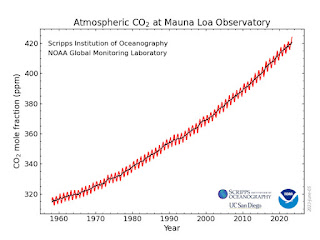
 

'Climate activism became a big public cause about halfway along this graph. Notice any effect?' From Riding the Climate Toboggan, John Michael Greer, 6 September 2023

But just because our knowledge of the causes of climate change is incomplete, that is not a reason for inaction or - the chosen course - for making ineffective policy. We don't have to wait for certainty. My suggestion is that, instead of basing policy on fossilised and incomplete science, we target our desired climate goal. This could be expressed as an array of quantifiable outcomes, each one of which would have to fall within a targeted range for a sustained period, before the goal would be deemed achieved. And once it has been achieved, and only then, the people who helped achieve it would be rewarded. The outcomes targeted could be physical (eg, temperatures), social (eg people made homeless by adverse climatic events), ecological (eg fates of keystone species), or financial (eg insurance rates for homes in developed countries). I suggest that governments, in conjunction with non-governmental organisations, philanthropists and others back Climate Stability Bonds, which would provide funds for the redemption of the bonds once the targeted outcomes had been achieved. The main advantages of such the bonds would be: 

  • the bonds would supply incentives for investors to explore, investigate and implement diverse, adaptive solutions to the climate change problem; and
  • the bonds would use market incentives to motivate people to be efficient in their pursuit of successful solutions.

For links to much more about Climate Stability Bonds, see here. 

14 September 2024

Finance, like dog food advertising, is a low priority

Social Policy Bonds are intended to channel our ingenuity and ever more impressive technology into achieving our social and environmental goals. I often suggest that many of the activities into which we currently devote boundless energy and resources are socially useless or in conflict with society's wishes. It is not only the relatively minor indulgences that somehow win society's approval against which I inveigh: advertising dog food for example, but such far more consequential resource sinks, such as nuclear weaponry (see my previous post), or finance: 

That’s finance. The total value of all the economic activity in the world is estimated at $105 trillion. ...The value of the financial derivatives which arise from this activity – that’s the subsequent trading – is $667 trillion. That makes it the biggest business in the world. And in terms of the things it produces, that business is useless. It does nothing and adds no value. It is just one speculator betting against another and for every winner, on every single transaction, there is an exactly equivalent loser.  For Every Winner a Loser: What is finance for?, John Lanchester, London Review of Books, 12 September 2024

We ought not to condemn those who choose financial trading as a career, whatever the net results of their collective actions. These people are reacting rationally to the incentives on offer. As Mr Lanchester says:
[I]n our society the classic three ways of making a fortune still apply: inherit it, marry it, or steal it. But for an ordinary citizen who wants to become rich through working at a salaried job, finance is by an enormous margin the most likely path. And yet, the thing they’re doing in finance is useless.
It's the incentives that are perverse, directing our efforts into socially useless, or worse, activities. One way of re-jigging the incentives would be to issue Social Policy Bonds, which would inextricably link the rewards gained by efficient resource allocation to the achievement of our social goals. These non-interest bearing bonds would be redeemable for a fixed sum only when a specified social goal. These goals would be broad and, importantly, meaningful to ordinary people, who could thereby participate in which goals would be chosen, and which would have higher priority. Such goals could include: reduced crime, an improved environment or, at the global level, nuclear peace, or a reduction in adverse climatic events. 

A Social Policy Bond regime would allow us to target broad global and national goals explicitly, while channeling the market's efficiencies into the best use of our limited resources. Given that the survival of the planet itself is under threat, I think the case for such targeting is a strong one, even if financial markets lose a fraction of their liquidity in order for us to get there.

12 September 2024

Bypass the generals and politicians: target nuclear peace

How do we get to the point at which the US has 14 US Ohio-class submarines, each one of which has the destructive power of 1250 Hiroshima bombs? It's a complicated, expensive, extremely dangerous way of achieving ...what exactly? I'm not singling out the US here: all countries are doing it. What I'm getting at is the disconnect between the stated goals of policies - in this case, presumably, national security - and the likely results of the way we go about achieving them.

As with other social and environmental problems, we really don't know the most efficient and effective ways of ensuring national security. But our decisions as to who gets to choose these ways embody the assumptions that the military, especially those generals who fought previous wars, are those who know best. I believe that there could well be other, less potentially disastrous, ways of achieving the security that we all yearn for, and that we should explore those ways. Actually, we can go further back and ask: who chooses the choosers? Those who delegate national security to the military are invariably politicians whose expertise lies in the acquisition and retention of power. 

I suggest we explore alternatives; or rather, that we put in place incentives that would encourage people to explore alternatives. A goal that we should target immediately is, in my view, sustained nuclear peace. It's one that probably everyone on the planet would like to see, and one whose achievement or otherwise is easy to monitor. If it's a priority at all, it's one that only a few dedicated people have as their vocation and for which they receive derisory funding. 

By backing nuclear peace bonds, a combination of governments, non-governmental organisations, philanthropists and ordinary people could increase the rewards to existing bodies working to achieve nuclear peace, but also increase the resources available for them - and, crucially, others - to work with in support of the nuclear peace goal. It would be up to highly motivated investors in the bonds to research, experiment and eventually implement the ways in which they best think nuclear peace could be achieved and sustained. To be sure, they might decide that the best way of doing so is for big countries to pile up masses of nuclear destructive potential and hope that nothing goes wrong. But they might also look into alternative approaches that pose less danger and that are being neglected by those who currently make all the relevant decisions.

We might then look at other social problems, and decide to target those directly, rather than via politicians and so-called experts working in organisations whose interests invariably differ from those of society.

So, if we want to raise literacy, why not target literacy directly? If we want to reduce crime, why not reward people for reducing crime, however they do so? If we want to improve the environment, why not target the well-being of human, plant and animal life? In short, why not target outcomes, rather than activities, institutions, inputs or outputs, and let the most effiicient operators, be they public- or private sector, rather than the taxpayer, be penalised for failure? Such would be the effect of a Social Policy Bond regime.

31 August 2024

Most environmental and social policies are ineffective

New Scientist says it bluntly, but truthfully:

Most climate policies aren't effective

I have been suggesting for many years now that, instead of enacting policies that are entirely focussed on cutting emissions of those gasses thought to contribute to climate change, we should be clear exactly what outcomes we wish to see, and then reward the people who do actually achieve those outcomes. Instead we have an array of divisive, expensive policies, such as subsidising the substitution of one type of car for another, that have done nothing to affect the climate. Even in their own terms - cutting greenhouse gas emissions - they have failed in their ostensible purpose:


'Climate activism became a big public cause about halfway along this graph. Notice any effect?' From Riding the Climate Toboggan, John Michael Greer, 6 September

If we were serious about tackling climate change we'd first answer the fundamental question: do we want to stop the climate changing, or do we want to mitigate adverse events caused by the climate? Then we'd admit that, while we don't really know how best to achieve either of these outcomes, we do know that a multitude of diverse, adaptive approaches will be required. Then we'd put in place incentives for people to research, experiment, refine and then implement these approaches, terminate those that are ineffective, and invest in those that are most promising. 

The problem is a wider one in the public sector: we do not express policy goals in terms of broad outcomes that are meaningful to ordinary people. Instead we put resources into existing institutions, which have their own agendas, top of which is usually self-perpetuation. These agendas may have little to do with the institutions' stated purpose, still less to do with bringing about meaningful improvements in environmental and societal well-being.

So we end up with the climate change bandwaggon, on which hordes of well-meaning, hard-working (for the most part), people are working in bodies whose finance depends on their carrying out specified activities, rather than actually improving the environment or society's well-being. Companies in the private sector - those that operate in a competitive market - don't have that luxury. When they fail, they go out of business. A Social Policy Bond approach, applied to the climate or to other goals, would impose such discipline on organisations that work in the public sector. Achieve what society wants you to achieve, and be rewarded. Fail and you disappear. It's not as harsh as it sounds, as everyone ultimately depends on our environmental and social policies being effective.

17 August 2024

Avoiding Armageddon - an alternative approach

The Economist asks What if South Korea got a nuclear bomb? 'Public support is high....' and, after all,

North Korea is believed to have dozens of nuclear weapons; its arsenal is already projected to grow into the hundreds by the end of this decade. ...Detractors counter that the [Korean] peninsula will inevitably become a much more dangerous place if South Korea goes nuclear. ....Untested leaders on both sides of the border will have their fingers on the nuclear trigger. The finale of this drama could see them stumbling into Armageddon. What if South Korea got a nuclear bomb?, 'Economist', 17 August

'[T]hem or 'us'? Because a nuclear exchange would be a global catastrophe, even it it did not spark a wider conflict. How are we, that is, the non-existent 'international community', going about reducing the probability of a nuclear conflict? It's a subjective view, but I'd say we're failing. Along with everyone else in the world, I can't see how we could convince those in control of nuclear weapons not to use them. What I can suggest is that we put in place incentives that would reward people who can achieve a sustained period of nuclear peace. If there are such incentives in place today, they're too meagre, because they're not working. We can't yet identify the best approaches to nuclear peace, but we can encourage people to research, experiment and follow such approaches.

Ideally, we'd also channel the market's efficiencies into efforts to bring about nuclear peace. We can do this, I suggest, by issuing Nuclear Peace Bonds. These bonds would be redeemable for a fixed sum only when nobody detonates a nuclear device that immediately kills, say, 100 people; such a period of nuclear peace to be sustained for, say 30 years, before the bonds would be redeemed. Backed by a combination of governments, non-governmental organisations, philanthropists and ordinary people, they would encourage a number of peace-generating approaches. Some would be less promising than others: the way the market for the bonds would work means that these efforts would be terminated and resources diverted into the more promising initiatives. 

A Nuclear Peace Bond regime would reward those who achieve peace, whoever they are and however they do so. It’s an admittedly unconventional approach. In its favour is that the funds used to back the bonds could be payable only if the bonds succeed, and nuclear peace reigns. And, the relevant question is: what is the alternative? The current approach has brought us to the brink of nuclear catastrophe. The taboo against threatening the use of nuclear weapons has already been broken. It now appears inevitable that, unless we actively support and pay for nuclear peace, the taboo against their use will also be broken. It’s now time to encourage and reward diverse, adaptive and successful ways of dealing with the looming nuclear threat.

10 August 2024

Why bother with the root causes of anaesthesia - or war?

Saying that we need to find the 'root causes' of our social and environmental problems, in the belief that doing so is necessary to solve them, can be a sincere and necessary position. It can also be a distraction, unnecessary, or a cynical excuse for inaction.

Despite the widespread presence of clinical anesthesiology in medical practice, the mechanism by which diverse inhalational agents result in the state of general anesthesia remains unknown. Mechanisms of general anesthesia: from molecules to mind, George A Mashour, Stuart A Forman, Jason A Campagna, Best Pract Res Clin Anaesthesiol 2005 Sep;19(3):349-64.

And even when identifying root causes turns out to be a necessary condition for solving our problems, it needn't be carried out by government. Social Policy Bonds work by rewarding the achievement of a targeted goal; how this is done, and by whom, are not specified - they don't need to be. Even the people who help achieve the goal need not necessarily know why exactly their methods work.

Take violent political conflict. It's still going on, killing, maiming and making homeless millions of people every year. We could spend years analysing past outbreaks of war, but still never get close to identifying root causes in ways that could be usefully be deployed to forestall future outbreaks. Society is just too complex, diverse and fast-changing. Policymakers should begin by specifying society's desired outcomes, and then put in place ways of rewarding those who achieve them, rather try to identify any root causes. Society and the environment are not like simple chemistry or physics. The entities and their relationships are not static. 

A bond regime wouldn't try to identify the root causes of war, which are a moving target anyway. Instead it would start by specifying exactly the outcomes we want to achieve, and then injecting market incentives into achieving those outcomes. The Social Policy Bond principle, applied to conflict, are the means by which I propose we begin to end all war for all time. There are many organisations, staffed by hard-working, dedicated people, already aimed at ending conflict. But their resources and influence are pitiful compared to the scale of the problem. We should acknowledge that our current ways of trying to bring about world peace are insufficient at the global level, and that we need to encourage new approaches. In economic theory, and on all the evidence, competitive markets, of the sort in which Social Policy Bonds would be bought and sold, are the most efficient way of allocating society's scarce resources. Conflict Reduction Bonds would channel the market's incentives and efficiencies into finding cost-effective solutions. They would would increase people's motivation and attract more resources into solving the problem of conflict, and the principle could be deployed to solve our other social and environmental problems. This is not idealism, of the sort that can be put into a box and hence ignored: it's giving incentives to motivated people to find solutions and rewarding only those who succeed in doing so.

02 August 2024

Funding drug trials

Monika Odermatt writes about the possibility of issuing Social Impact Bonds to fund certain drug trials: 

I had the pleasure of speaking with Dr. Rick Thompson, CEO [of Reboot Rx]... [I asked] him about the drug repurposing social impact bond (SIB), the challenges he has encountered, and his perspective on the future of SIBs. According to Rick, the following ingredients are key to a successful SIB: flexibility, imagination, and funding. There is a need for flexibility in order to have an open mind and learn from the experiences of other organizations who have worked with SIBs before; imagination in order to overcome hurdles one encounters when trying to implement a SIB, and to find ways to collaborate with other countries and partners; and impact investors to fund the SIB and trials. Social impact bonds could fund drug repurposing clinical trials, Monika Odermatt

I agree, and intend to contact Reboot Rx, along these lines: The flexibility I'd like to see is the sort that would make the bonds tradeable. Finding cures for the rare diseases mentioned is inevitably going to be a long-term endeavour. The incentives on offer should encourage efficient new approaches, and terminate failing approaches. Funds should be channelled into organisations that are most efficient at achieving goals along the way to success; likely to be a multi-step process, in which each step is best taken by organisations with specific strengths. The cast of actors should be flexible enough to encourage efficiency at every stage of the path to success, which means that those who succeed at one step should be able to benefit from the incentives without having to proceed to the next step, in which they may have little expertise. 

I've written elsewhere about the need to make the bonds tradeable for long-term goals such as those of Reboot Rx, and other goals that will inevitably take decades to realise. These include nuclear peace and other forms of conflict reduction, climate stability and other environmental goals.

17 July 2024

Incentives matter - more than we want them to

Theodore Dalrymple writes about the UK's public sector:

Everywhere one looks, one sees evidence of things not done properly, but nevertheless expensively. It is as if the real purpose of public expenditure were first to assure the pensions of those working, or ever to have worked, in the public sector, and to assure the employment of hordes of consultants, special advisors and the like. With expenditure about 25 per cent lower than Britain’s own defence, France has more than 33 per cent more soldiers, more than twice as many tanks, six times as many military satellites, and more ships in its navy. The cost of HS2 to Manchester [from London, a distance of 184 miles] is projected to be more than twice the whole of Spain’s entire high-speed railway network (the largest in Europe). While there are good reasons why it is cheaper to build such railways in Spain, they surely cannot explain why in Spain it takes less than 5 per cent of what it costs in Britain to build a mile of such railway. Corruption legalised, Theodore Dalrymple, the Salisbury Review, 21 March 2024

The Consciousness of Sheep explains why:

[I]n the immortal words of Upton Sinclair, “It is difficult to get a man to understand something, when his income depends on his not understanding it.” That is, if MPs [in the UK] had a financial interest in getting infrastructure projects done, they would do so. The fact that they do not is at best evidence of their turning a blind eye, and at worst of direct collusion. What would Xi do?, Consciousness of Sheep, 17 July 2024

Financial incentives matter. Sadly, in my view, more than they should, more than we might want them to. But in our highly aggregated, increasingly diverse and mobile societies, they are almost the only thing that matters. It's a shame, I think, but it's a fact. The Social Policy Bond concept is an attempt to inject financial incentives into the achievement of our social goals, channelling our self-interest into more socially beneficial ends than the mere accumulation of wealth gained by undertaking activities of no or negative social benefit. 

In so many areas, the financial incentives to create social problems are immediate, highly visible and (still) socially acceptable. Two examples

  • Selling weaponry without which large-scale war would be less likely, is highly profitable, while the rewards and resources on offer to peace makers are nugatory, and unrelated to their success of failure in preventing war.  
  • The social costs (negative externalities, in economics parlance) of mining, production and consumption are largely imposed on our air, water and land. In former times, such costs of exploitation might have been low, relative both to the planet's capacity to absorb them and to the benefits derived from doing so. But that doesn't apply today, and while we do try to regulate some of the environmental burdens, the incentives to forestall, undermine or ignore such attempts are huge, while the incentives for legislators and those trying to preserve the environment are both low and uncorrelated to their success or otherwise in doing so. 

In both war and the environment, and in other policy areas, Social Policy Bonds could be issued that would go some way to rejigging the incentives. The bonds would enhance the rewards to those engaged in achieving our social and environmental goals and, importantly, divert resources away from those creating problems and towards those dedicated to solving them.

29 June 2024

Why don't we trust politicians any more? It's (largely) our fault

In her article Why no one trusts politicians any more, Camilla Cavendish writes about ways of closing the gap between politicians and the people they are supposed to represent:

The usual proposals - tightening the ministerial code, properly regulating the revolving door between public office and business and stopping abuses of the honours system - would all help. But they will not address the deeper issue of eroding faith in government: the lack of accountability for failure. Financial Times, 29 June 2024

I agree.

[G]overnment bureaucracies non-self-evaluate. At a minimum, agencies with evaluative responsibilities are not invited to evaluate - they are kept out of the loop, their opinions unsought. At a maximum, government agencies actively suppress their own internal evaluative units and are discouraged from evaluating the beliefs and policies of other agencies. Why States Believe Foolish Ideas: Non-Self-Evaluation By States And Societies (pdf), Stephen Van Evera, Massachusetts Institute of Technology Political Science Department and Security Studies Program, 2002

Our politicians and bureaucrats can get away with this, because their stated goals are rarely expressed as meaningful, verifiable outcomes. They talk about vague, lofty ideals; or about policies, which are means to ends, rather than outcomes, which are ends in themselves, and which are more difficult to achieve. So low and entrenched are our expectations of our governments that even radical attempts to change things - see my previous post about injecting AI into politics - ask for no more than policy proposals when, in my view, we should be discussing, costing and prioritising policy goals.

That's not the whole answer

Another explanation for why our politicians disappoint is one that perhaps nobody in the media really wants to cite: the very high costs of becoming and being a member of a democratic government. These costs, borne by aspiring politicians and their families, include the intense, unceasing and merciless scrutiny of their current and past behaviour, the constant threats to their physical security and consequent the loss of privacy - which will continue when they leave office. The opportunity cost of entering politics has also risen in line with the relatively great financial rewards from alternative professions, such finance, the law, computing. As a result, the pool of potentially highly capable politicians who care about their country has shrunk. We are left with the mediocre, the thick-skinned, the power-seekers, the ideologues and the ones who cannot find employment elsewhere. There remain few who have any appealing long-term vision for their country.

A Social Policy Bond regime could help by taking away some of the powers of these democratic governments. Under a bond regime, governments would continue to do what they can do well: articulating society's wishes and raising the revenue for their achievement; but they would contract out the actual achievement of our goals to investors who would have incentives to achieve them efficiently and quickly. Politicians and officials would lose the power to allocate funding to their favoured bodies. That is a matter of resource allocation which in theory and practice has been shown to be best done by competitive markets.

18 June 2024

AI enters politics

Some early applications of Artificial Intelligence (AI) are being reported. In the UK, Steve Endacott, or "AI Steve" is asking the constituents of Brighton and Hove to submit policy proposals:

Endacott created the AI candidate’s initial platform, for example, and the campaign wants to recruit 5,000 people to be “creators”—these are the folks who will have discussions with the chatbot—to surface potential policies. ...These people, everyday Brighton commuters, will review and rate AI Steve’s policies on a scale of 1 to 10. Source

I think asking people for their preferred policies is a missed opportunity: we should be asked what are our preferred goals. Policies are a means to an end. Very often they don't achieve their stated goals, or do so inefficiently and in conflict with other goals. For most of us, it's not policies that are important; it's how closely society's goals are met. (I've written to AI Steve along these lines.)

A political application of AI in the US looks more promising. Victor Miller, running for mayor of Cheyenne, Wyoming, has created a chatbot ("VIC") that would call the shots:

Miller fed VIC the supporting  documents - emails, public records, notices - from past Cheyenne Fity Council meetings... By analyzing these documents, Miller says VIC will learn to make policy recommendations, figure what's important and decide how to vote in council meetings. "It's unlikely that a human can read, say, 400-plus supporting documents between meetings," he says, "But VIC can do that[.] An AI Bot Is (Sort of) Running for Mayor in Wyoming, Vittoria Elliott, wired.com, 12 June 2024

A possible danger of injecting AI into politics is that it could be used to entrench existing inefficient and opaque policymaking systems by making them easier to work with. My hope is that it can help in the articulation, prioritising and costing of society's goals - a necessary condition for implementing the Social Policy Bond concept.